
Monetary Policy- Easing expected to happen later this financial year.

India's wholesale price inflation surged to 8.30 per cent in April, up from 3.88 per cent in March, primarily driven by a significant increase in the prices of fuel, power, and crude petroleum, according to data from the commerce and industry ministry.

ITC reported a 6.1 per cent year-on-year growth in its consolidated adjusted net profit from continuing operations, reaching ~5,469.74 crore in the January-March quarter (Q4FY26), primarily fuelled by strong performances in its cigarettes and non-cigarette fast-moving consumer goods (FMCG) businesses.

India is likely to see above-normal rainfall in the four-month monsoon season (June to September) with cumulative rainfall rainfall estimated at 106 percent of the long-period average (87 cm), he said.

'Can you believe there are over 26,500 deaths linked to heatwave-driven ozone in 2024?'

This is the time for India to plan forward fully, with the goal of Atmanirbharata, and energy security. The Persian Gulf is no longer a reliable source, points out Rajeev Srinivasan.

Even if there is an early agreement on a cessation of hostilities in West Asia, the price shock will not go away easily, points out A K Bhattacharya.

The Reserve Bank of India (RBI) Governor Sanjay Malhotra is now confronting the classic growth-inflation tradeoff, a situation exacerbated by the West Asia war, which threatens to end the 'goldilocks period' of low inflation and robust growth.

Revenue collection next financial year may be affected, and, along with this, subsidies on food and fertilisers can go up if the war in West Asia drags for long, according to experts.
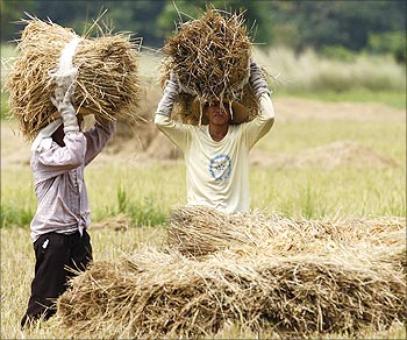
This may also be the second-strongest El Nino after 1998. El Nino winds bring drastic changes in the weather pattern, which will hit the agriculture sector.

Spurred by cyclone Remal, the southwest monsoon set in over the Kerala coast and parts of the northeast on Thursday, a day earlier than forecast by the weather office.

'Monsoon is the pran (life) of our water system.' 'A weak monsoon will have a very negative impact on crops and people's lives.'

Also, the monsoon this year may end up being the driest since 2015, which recorded a rainfall deficit of 13 per cent, they said.

Conditions were becoming favourable for further advance of the southwest monsoon over some more parts of the south peninsula and east India and adjoining areas between June 18 and 21.

The southwest monsoon season concluded on Saturday with India receiving 'below-average' cumulative rainfall -- 820 mm compared to the long-period average of 868.6 mm -- in an El Nino year.
The country can expect normal rainfall during the southwest monsoon season as a positive Indian Ocean Dipole (IOD) and a lower snow cover over the northern hemisphere are likely to counter the evolving El Nino conditions, the India meteorological department (IMD) said on Tuesday.

India's peak power demand is projected to hit 270 GW this summer, surpassing last year's record of 250 GW.

India is likely to see above-normal maximum and minimum temperatures in most parts of the country in the March to May period, IMD director general Mrutyunjay Mohapatra said at a press conference.

India is likely to experience below-normal monsoon rainfall this year, with a 20 per cent chance of drought due to the end of La Nina conditions and the potential for El Nino to take hold, private forecasting agency Skymet Weather said on Monday.

On May 15, the weather office had announced the onset of monsoon over Kerala by May 31.

Skymet expects a good monsoon over western and southern India.

June rainfall accounts for 15 percent of the total precipitation of 87 cm recorded during the four-month monsoon season in the country.

East and northeast India recorded 29 per cent rain deficit -- 141.5 mm against the normal of 199.9 mm -- from March 1 to May 3.

Scientists had earlier said the cyclone pulled the moisture and convection, impacting the intensity of the monsoon and delaying its onset over Kerala.

Ten to 20 days of heatwave are expected against the normal of four to eight days in the entire April-June period.

Dozens of farmers have already committed suicide in India after damage from unseasonal rains this year.

East India, along with a major portion of central India, is likely to be at a higher risk of being rain deficient, especially during the first half of the season.

El Nino refers to abnormal warming of surface ocean waters in the Pacific that disrupts weather pattern causing drought and floods in many regions of the world.

The El Nino risks for this year is rising in India and it could result in sub-par rains, says a report.

Addressing a press conference virtually, India Meteorological Department Director General Mrutyunjay Mohapatra said September was likely to witness normal rainfall in the range of 91-109 per cent of the long period average of 167.9 mm.
Heatwave conditions have been prevailing in Odisha since April 15 and the Gangetic West Bengal since April 17, according to the MeT department.

India has received 20 per cent less rainfall since the start of the monsoon period on June 1, with the rain-bearing system making no significant progress between June 12 and 18, according to the India Meteorological Department (IMD).

The IMD DG said there should not be an impression that climate change leads to rise in the temperature, but on the contrary, it leads to erratic weather.

Sri Lanka and southern India could continue to experience higher than normal rainfall and this could cause further flooding, particularly urban flooding, in certain locations, the report said.

Israel has for more than two decades and several US presidencies worked to draw the United States into a full-scale war with Iran. Having finally achieved that, the last thing it wants is Trump declaring victory and going home, as he is prone to do. Ali Larijani was the figure most capable of handing Trump a negotiated exit with something to show for it. Without Larijani, the road to an exit gets considerably narrower. Prem Panicker continues his must read daily blog on the Gulf War.

The southwest monsoon has arrived in Mumbai 16 days before its usual date, making it the earliest arrival since 1950. This early onset follows the monsoon's arrival in Kerala, the southernmost state, on Saturday, marking the earliest arrival since 2009. The India Meteorological Department (IMD) predicts an above-normal rainfall for the 2025 monsoon season, with rainfall between 96 per cent and 104 per cent of the 50-year average of 87 cm considered 'normal'. The monsoon is crucial for India's economy, providing vital water for agriculture and replenishing reservoirs.

Lakhs of voters will have to bear the searing heat when they step out to exercise their franchise in the second phase of the Lok Sabha elections on Friday.

The India Meteorological Department (IMD) seems to have taken a cautious stand over the World Meteorological Organisation's (WMO) projection of a 'poor monsoon' due to a probable 'El Nino' impact. The IMD did not agree with WMO's projections, saying, "El Nino and the progress of monsoon are not mutually exclusive events", and remained non-committal over its earlier projection of a "normal monsoon" for the June-September 2009 season.

El Nino is expected to occur in August-September, but it is unlikely to have any major impact on the monsoon, and the weatherman expects a positive Indian Ocean Dipole, which has a strong influence on rainfall in the country.
There is a substantial possibility of the emergence of La Nina, the opposite of El Nino, which invariably has a positive influence on the monsoon.
